

The warehouse goes live on Friday. The first scheduled load completes, the reports refresh, and the project is declared successful.
On Monday, a large query delays the morning load. An upstream field changes on Tuesday. By Wednesday, one dashboard is showing yesterday’s data while another has refreshed. The person who understood the recovery procedure has already moved to a different project.
None of these problems means the original design was worthless. They show that a deployed solution and an operated service are different things.
Operational gaps hidden by a successful launch
 No agreed definition of how fresh the published data needs to be.
- Alerts report failed jobs, but not stale or incomplete business results.
- Capacity was sized for test data rather than concurrent production demand.
- Backups exist, but nobody has timed or verified a realistic recovery.
- Broad project access remains after the delivery team changes.
- Schema and rule changes have no dependable promotion or rollback path.
Launch Changes the Kind of Work
Before launch, a team can plan test windows, control who uses the environment, and pause while a defect is investigated. Production has reporting deadlines, concurrent users, upstream dependencies, access requests, incidents, and changes that can’t all wait for a convenient moment.
The operating model needs to cover five connected responsibilities:
01
Performance
Keep important loads and analytical queries within useful time boundaries.
02
Observability
Detect service degradation and retain enough context to diagnose it.
03
Recovery
Restore an agreed service and data state after failure or corruption.
04
Security
Protect data and administrative capabilities throughout their lifecycle.
05
Change
Improve the solution without surprising consumers or losing control of production.
Microsoft’s Azure Well-Architected Framework organises related concerns into reliability, security, cost optimisation, operational excellence, and performance efficiency. A warehouse doesn’t need to be hosted in Azure for those concerns to be useful. The important point is that workload quality involves tradeoffs across them rather than a single measure of technical success.
Turn Expectations into Service Objectives
“The warehouse should be available” sounds reasonable but leaves several questions unanswered. Available to whom, for which use, at what time, and with data from which source boundary?
Freshness
When must each published dataset represent source activity up to, and how will lateness be communicated?
Availability
During which business periods must ingestion, query, administration, and reporting capabilities be usable?
Recovery
How quickly must service return, and how much recent work could acceptably be replayed or lost?
Support
Who responds at different times, what counts as a serious incident, and who communicates with affected users?
The answer won’t be identical for every dataset. A regulatory balance used each morning may justify tighter controls than an exploratory marketing dataset refreshed weekly. A single universal service level can waste resources on low-value data while providing insufficient protection for business-critical information.
The service objectives should connect to business consequences. If a two-hour delay prevents a finance team from completing a close, that impact helps establish monitoring priority, escalation, and recovery investment.
The Build-and-Load Process Becomes an Operating Loop
Testing, monitoring, recovery, and change aren’t activities attached after the architecture is complete. They feed one another. Monitoring reveals a capacity trend. A controlled change addresses it. Testing provides evidence before release. A recovery path limits the effect if the change behaves differently in production.
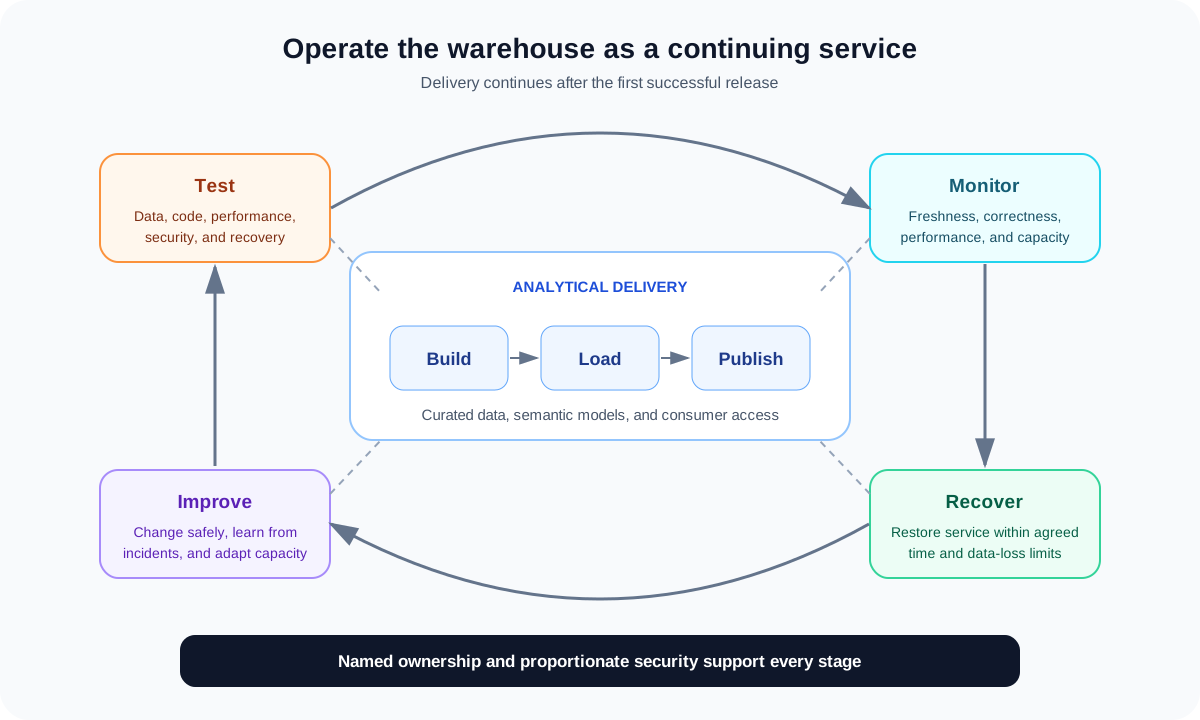
Operating the warehouse extends delivery into a loop of evidence, response, recovery, and safe improvement.
Ownership and security sit beneath the loop because every stage depends on them. An alert without an owner is only a recorded symptom. A recovery process that requires unavailable privileges or exposes unrestricted backup data isn’t ready to use.
Performance Is a Workload Property
A query that runs quickly in development may compete in production with ingestion, transformation, semantic-model refreshes, data-science work, and other users. Data grows. Usage patterns change. A report introduced six months later may create a workload that the original capacity test never represented.
Useful performance management starts with representative baselines:
- Load duration and completion relative to publication deadlines.
- Query response for important interactive and scheduled workloads.
- Data volume, concurrency, compute, memory, storage, and movement trends.
- The effect of maintenance, refreshes, and background processing on user activity.
- Bottlenecks within models and queries before assuming more capacity is the answer.
Capacity is both a technical and economic boundary. Extra resources can hide inefficient processing, while aggressive cost reduction can make normal demand unreliable. The useful decision is the level of capacity and isolation that meets the service objective at an acceptable cost.
The current Microsoft documentation describes the Capacity Metrics app as the detailed view of capacity consumption and the Monitoring hub as a place to track Fabric activities. These are useful product capabilities, but the durable requirement is broader: the team needs evidence from individual jobs, shared resources, and user-facing outcomes.
Monitoring Must Lead to Action
Collecting logs and drawing dashboards doesn’t automatically create observability. The team needs to infer what is happening, understand likely impact, and decide what to do next.
| User-visible concern | Useful signal | Example decision boundary | Likely owner |
|---|---|---|---|
| Morning figures are stale | Published watermark and source-to-publish delay | Critical dataset misses its agreed publication time | Data operations owner |
| A report is slow | Query duration, concurrency, and capacity pressure | Important interaction exceeds its performance objective | Platform and model owners |
| A total is incomplete | Reconciliation difference and rejected-record trend | Unexplained difference exceeds agreed tolerance | Data product owner |
| A load is repeatedly failing | Failure rate, retry count, dependency status, and last successful boundary | Retry policy is exhausted or the next deadline is at risk | Pipeline owner |
| Access may be inappropriate | Permission changes, audit events, unusual retrieval, and dormant accounts | Privileged or sensitive access breaks policy | Security and data owner |
A threshold should reflect normal variation and business impact. An alert that fires every night and requires no action trains people to ignore it. An alert that says only “pipeline failed” may still leave the responder searching for the affected dataset, last safe state, upstream dependency, owner, and recovery procedure.
Monitoring that looks complete but isn’t operational
 Dashboards exist, but nobody is accountable for reviewing them.
- Technical failures are tracked, but stale or incorrect data isn't.
- Thresholds were copied from defaults and don't reflect normal demand.
- Alerts contain no affected service, severity, owner, or response link.
- Telemetry disappears before a slow trend or recurring incident can be analysed.
- Averages hide the periods and users experiencing unacceptable performance.
Incidents should leave more than a resolved ticket. Repeated failures can reveal a weak dependency, missing test, unrealistic service objective, fragile manual step, or capacity assumption that needs to change.
Recovery Is a Tested Capability
A backup proves that some data was copied somewhere. It doesn’t prove that the complete analytical service can be restored, that the copy is usable, or that the team can recover within an acceptable time.
Two boundaries help make the requirement concrete:
RTO
Recovery time objective
Describes how long service restoration may take after an interruption.
How long can the service remain unavailable?
RPO
Recovery point objective
Describes how much recent data or processing the organisation can accept losing or replaying.
How much recent processing can be replayed or lost?
These are business decisions before they become technical configurations. Near-zero targets can require replication, redundancy, automation, specialist support, and higher cost. A less critical service may reasonably accept a longer rebuild from governed source data.
Recovery also depends on what failed. The response to an unavailable service differs from the response to corrupted transformations, accidental deletion, compromised credentials, or a silently incorrect publication. A runbook should identify the last trusted state, dependencies, required access, validation steps, communication route, and authority to republish.
Microsoft’s reliability guidance emphasises recovery to an agreed state within an agreed period and the need for an incident response plan. It also describes reliability choices as tradeoffs that can add cost, security surface, and operational complexity in its discussion of reliability tradeoffs.
Security Extends Beyond the Curated Tables
The warehouse may contain several representations of similar business information. A source-shaped landing area can retain fields removed from the curated model. Rejected records may contain sensitive values alongside quality errors. Audit logs, extracts, temporary structures, and backups can all require protection.
The NIST definition of least privilege is a useful starting point: users and processes receive only the access needed for their assigned functions. In a warehouse, that principle applies separately to administration, pipeline execution, development, support, data ownership, modelling, and consumption.
Access design should consider:
 Data scope: Which domains, rows, columns, and historical versions does the role need?
- Capability: Can the identity only read, or can it create, alter, share, publish, or administer?
- Environment: Should development access imply anything in test or production?
- Process identity: What can each automated workload access, and how are its credentials rotated?
- Lifecycle: Who reviews access when people, teams, projects, or responsibilities change?
- Evidence: Which access, permission changes, and sensitive operations must be auditable?
Product roles are rarely the complete security model. For example, Fabric workspace roles grant broad workspace capabilities, while warehouse sharing and data-plane permissions can control narrower access. Microsoft’s current guidance documents both workspace roles and warehouse permissions. The right combination depends on what a person or process needs to do.
Safe Change Is Part of Reliability
Warehouses change because sources, definitions, users, regulations, volumes, and technologies change. Preventing all change would preserve today’s defects and make the service less useful over time.
A controlled change path should answer:
- What requirement or incident justifies the change?
- Which pipelines, tables, measures, reports, exports, permissions, and users depend on the affected behaviour?
- Which automated and human checks will establish that the change is safe?
- How will code, configuration, and database changes move between environments?
- Can old and new components coexist during deployment?
- What will trigger a rollback or forward correction, and what data repair might be needed?
- Who needs to approve, operate, or be told about the release?
Source control and automated deployment help, but a database change isn’t always reversible by redeploying old code. Dropping a column, rewriting historical values, changing grain, or altering a business rule may require a separate data recovery and consumer transition plan.
Microsoft’s current Fabric Warehouse deployment guidance describes schema promotion across development, test, and production workspaces. It deliberately excludes security principals from warehouse deployment and blocks table drops by default, illustrating why schema, data, and access changes need related but distinct controls.
Operational Readiness Needs Evidence
A production-readiness review should test whether the service can be operated by the named team, not whether the project has produced enough documents.
Evidence of an operable analytical service
 Measurable freshness, availability, performance, recovery, and support objectives for important workloads.
- Named technical and business ownership with escalation and communication routes.
- Monitoring that covers dependencies, data outcomes, user experience, capacity, cost, and security events.
- Actionable alerts linked to severity, affected service, diagnostic context, and a maintained response procedure.
- Representative performance baselines and capacity trends, including concurrent and background demand.
- Tested recovery procedures with recorded time, restored data boundary, validation, and unresolved gaps.
- Reviewed human and process access across environments and data states, with auditable changes.
- Controlled promotion, dependency testing, consumer communication, and recovery plans for production changes.
- Retention and lifecycle rules for staged, rejected, curated, audit, monitoring, and backup data.
- A regular process for learning from incidents, usage, cost, security findings, and changing business needs.
Some services need sophisticated automation, regional resilience, and round-the-clock support. Others need a clear weekday owner, a dependable rebuild, and honest communication when a weekly dataset is delayed. Operability is proportional to purpose and consequence, not the number of tools installed.
The architecture still matters. Storage, compute, workload isolation, data formats, deployment capabilities, security boundaries, and recovery options all affect what the team can operate. Those choices should follow the requirements established across this series.
Questions for the Architecture Decision
The final article compares warehouse, lake, lakehouse, and modern analytical-platform ideas without treating a product label as the starting point.
- Which data structures and access patterns must the platform support well?
- Where do enterprise integration and reusable business definitions need to happen?
- Which workloads require independent scaling, isolation, or specialised processing?
- What governance and security boundaries must remain consistent across storage and serving layers?
- How portable, interoperable, or open do data and processing interfaces need to be?
- Which operational capabilities can the team genuinely support after launch?
Those questions lead into Article 8: choosing an analytical architecture from the workload, governance, delivery, and operating requirements rather than beginning with the newest platform category.