
The current AI adoption challenge
Much of the current AI agent guidance focuses on getting started quickly. That’s useful for experimentation and learning, but enterprise adoption introduces a different set of problems.
Organizations need to decide which use cases are worth pursuing, which platforms are appropriate, how agents should access data, who owns them, how they are governed, and how they will be operated after deployment.
Of course, you can create your own adoption framework from scratch, but the better option is often to adapt one that already exists.
Why the Microsoft AI agent adoption framework?
Microsoft remains one of the dominant enterprise technology providers globally. As a result, many organizations already rely on its products for identity, productivity, collaboration, security, and cloud infrastructure.
With that in mind, it stands to reason that Microsoft would have created a methodology to help organizations adopt AI agents responsibly. Spoiler alert: they did.
The AI agent adoption framework is a subsection of the wider AI adoption framework. This article focuses on the former.

Understandably, the framework references Microsoft’s own products and services when discussing implementation options. However, one of the more interesting aspects of the guidance is how much of it remains applicable regardless of the technology stack you choose. Business planning, governance, organizational readiness, data architecture, and operational processes are concerns that exist whether you build agents with Microsoft technologies or competing platforms. For that reason alone, the framework is well worth reading and adapting to your own environment.
What is an AI agent?
It’s useful to have a basic idea of the Microsoft definition of an agent.
My interpretation is that Microsoft’s definition overlaps heavily with ReAct-style agents, while also encompassing memory, orchestration, triggers, and multi-agent patterns.
Adoption overview
The framework consists of four key areas broken down into sub-plans and activities, each containing further granular detail.
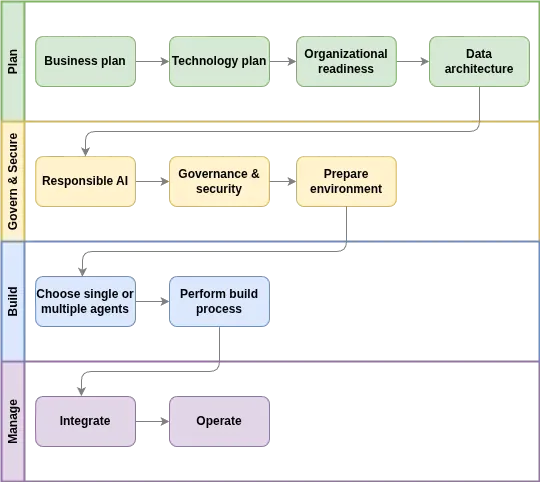
Microsoft AI agent adoption framework process showing the Plan, Govern, Build, and Manage phases.
AI agent adoption key areas
Plan
Business value, technology choices, organizational readiness, and data architecture.
Govern
Responsible AI, security controls, identity, access, and risk management.
Build
Agent design, platform selection, implementation, testing, and integration.
Manage
Integrating agents into business processes and operating them as governed organizational capabilities.
Build is only part of the process
One of the first things that stands out is that most of the framework isn’t actually about building agents.
Three of the four major phases focus on planning, governance, organizational readiness, and operational considerations before or alongside implementation activities.
That emphasis is clearly very deliberate and, in my opinion, reflects the realities of enterprise adoption far more accurately than many of the “build an agent in five minutes” examples commonly seen online.
It’s an iterative process
Although the framework appears sequential, it’s unlikely that individual plans will be finalized after their first draft.
For example, an initial business plan will almost certainly evolve as technology decisions, governance requirements, and organizational considerations become clearer.
This is an iterative process, not a waterfall methodology.
Business plan
A lot of AI content focuses on what agents can do. However, Microsoft makes a point of discussing when organizations shouldn’t build them at all.
That may sound obvious, but I think it’s one of the most important messages in the entire framework.
Before considering agents, the framework encourages organizations to ask whether the problem could be solved using:
 Traditional software?
- Nongenerative AI?
- A simple RAG solution?
- An existing SaaS product?
In other words:
Don’t build an agent simply because agents are fashionable.
From a business systems analysis perspective, this resonates strongly with me. The best outcome of a discovery exercise won’t necessarily be an AI implementation. It’ll come from identifying the most appropriate solution to the business problem.
Start with business value
The framework emphasizes that every potential agent initiative should be linked to measurable business outcomes before technology decisions are made.
Certain questions should be answered before any discussion about models, frameworks, orchestration patterns, or implementation platforms.
- What problem are we solving?
- How will we measure success?
- What value will the organization receive?
- Is the investment justified?
This might seem less exciting than discussing the latest agent framework, but it’ll likely be where successful projects are won or lost.
Prioritizing use cases
Another aspect I like is Microsoft’s use of a scoring system to prioritize use cases in order to determine which ones are strong and which ones need more work.
Business impact
Determine whether the use case supports strategy, creates real value, and fits within a reasonable adoption window.
Technical feasibility
Determine whether your organization can build and operate the agent safely and reliably.
User desirability
Determine whether people want the solution and are likely to use it. Even high-value, technically feasible use cases can fail without user buy-in.
For any kind of automation initiative, many organizations can generate dozens of possible use cases within a few workshops. The difficult part is deciding where to start.
Personally, I think there’s a temptation to prioritize the use case with the highest theoretical ROI. While that can be the right decision, there’s also value in selecting initiatives that can demonstrate success quickly.
The benefits of early wins
 Build organizational confidence
- Generate internal support
- Improve stakeholder engagement
- Create momentum for larger initiatives
A modest use case that delivers value in six weeks may ultimately contribute more to long-term adoption than a highly ambitious project that takes a year to show results.
My takeaway
If I had to summarize this section in a single sentence, it would be:
Agent adoption should begin with business value, not technology.
That sounds simple, but I suspect it is one of the reasons many AI initiatives struggle. It’s easy to fall into the trap of asking what can be built, but the real question is:
What problem is actually worth solving?
Technology plan
The next section focuses on selecting the right implementation approach.
I think it’s notable that Microsoft’s guidance doesn’t immediately jump into discussing frameworks, models, or architectures. Instead, it introduces a decision-making process designed to avoid unnecessary complexity. The framework effectively asks three simple questions.
- Can we solve this without an agent?
- Can we use an existing SaaS agent?
- If not, should we build a custom solution?
That may seem like a simple progression, but it reflects a mindset that many organizations will benefit from adopting.
Don’t build what already exists
One of the recurring themes throughout the framework is avoiding unnecessary development effort.
If an existing solution already satisfies the business requirements, the Microsoft recommendation is generally to adopt rather than build.
Its examples include:
- Microsoft 365 Copilot agents
- GitHub Copilot agents
- Dynamics 365 agents
- Security Copilot agents
- Microsoft Fabric data agents
Obviously, Microsoft have suggested their own products here, but the principle stands regardless of vendor, and the underlying message makes perfect sense:
Custom development should create competitive advantage, not recreate functionality that already exists.
Building and maintaining custom solutions introduces cost, complexity, support overhead, and governance responsibilities. If a mature product already solves the problem, there should be a compelling reason to build something new.
Choosing a build path
When a custom solution is required, Microsoft presents four broad approaches:
| Approach | Typical Focus |
|---|---|
| SaaS Agents | Fastest time-to-value with minimal customization |
| Copilot Studio | Low-code development with Microsoft-managed infrastructure |
| Microsoft Foundry | Greater flexibility and deeper customization |
| Custom Infrastructure | Maximum control and responsibility |
What I like about this model is that it treats technology selection as a business decision rather than a purely technical one.
The “best” platform depends on answers to specific questions.
- Required customization?
- Governance requirements?
- Available skills?
- Time-to-market expectations?
- Operational overhead?
- Long-term support requirements?
These are often more important than individual product features.
Single agent or multiple agents?
The framework also introduces a question that frequently appears in AI discussions:
Should this be a single-agent or multi-agent solution?
I appreciated Microsoft’s recommendation to start simple.
There’s currently a lot of excitement around multi-agent systems, but additional agents introduce additional complexity. Communication patterns, orchestration, observability, testing, governance, and failure handling all become more challenging as the number of agents increases.
Microsoft’s guidance is effectively:
Prove that a single agent is insufficient before introducing additional agents.
That strikes me as sensible advice.
My takeaway
The strongest message I took from this section is that platform selection should be driven by business outcomes rather than technical enthusiasm.
It’s easy to become distracted by new agent frameworks and architectural patterns. The framework repeatedly encourages organizations to choose the simplest approach that satisfies the requirements.
In practice, that often means:
Buy before you build, and build before you over-engineer.
Organizational readiness
Anecdotal evidence is beginning to show this is probably the most overlooked area of AI adoption.
Conventional advice often focuses on models, prompts, and tools, followed by platforms and architectures, but contains comparatively little discussion about how AI solutions will be supported, governed, and adopted once they are deployed.
The Microsoft framework places organizational readiness alongside technology planning and data architecture, which I think is exactly where it belongs.
AI adoption is a people challenge
One of the key themes throughout this section is that successful AI adoption requires more than technical capability.
Organizational needs
- Clear ownership
- Defined responsibilities
- Appropriate governance
- The right skills
- Effective change management
Without these foundations, it’s easy for AI initiatives to become isolated experiments that never progress beyond a proof of concept.
I’ve seen many discussions focus on what an agent can do. Far fewer focus on operational concerns.
Operational concerns
- Who owns it?
- Who maintains it?
- Who approves changes?
- Who monitors outcomes?
- Who is accountable?
Those questions become increasingly important as AI moves from experimentation into production.
Separating platform and workload responsibilities
One aspect of the framework that I particularly liked was the distinction between platform responsibilities and workload responsibilities.
Platform team
Focus on providing secure, governed foundations that can be reused across the organization.
Workload teams
Focus on delivering business value through specific solutions.
This separation helps prevent every project team from independently solving the same governance, security, and operational problems.
It also creates a scalable operating model where innovation can happen within established guardrails.
The role of an AI Center of Excellence
The framework also recommends establishing an AI Center of Excellence (CoE).
In practice, I don’t view this as a centralized team that owns every AI initiative. Instead, I see it as a mechanism for delivering best practice.
- Sharing expertise
- Promoting standards
- Avoiding fragmented adoption
Without some form of coordination, different teams can easily:
 Duplicate effort
- Apply inconsistent governance controls
- Use conflicting tooling
- Create disconnected data strategies
A CoE can help provide consistency while still allowing individual business units to innovate.
Skills matter more than tooling
Another observation I strongly agree with is the framework’s emphasis on skills development.
The framework highlights certain core AI capabilities:
- Prompt engineering
- Agent optimization
- AI governance
- Data engineering
- AI security
These aren’t niche specialist topics anymore. They’re increasingly becoming foundational skills for organizations that want to adopt AI responsibly.
Technology platforms will continue to evolve rapidly. The ability of teams to understand, evaluate, govern, and improve AI systems is likely to remain valuable regardless of which platform happens to be popular at the time.
Change management cannot be an afterthought
The emphasis on change management is refreshing, as a lack of it has always been a significant risk to many projects’ potential for success.
Even a technically successful solution can fail if users don’t trust it, understand it, or see value in adopting it.
Critical components of successful AI adoption must include:
- Training
- Expectation management
- Stakeholder engagement
Organizations aren’t simply deploying software. They’re introducing new ways of working.
My takeaway
I think the lesson here is that scaling AI requires organizational maturity, not just technical capability.
An impressive proof of concept can often be built by a small team, but creating an environment where dozens or hundreds of AI solutions can be deployed safely and consistently across an organization is a very different challenge altogether.
Data architecture
If the previous section focused on people, this section focuses on something equally important: data.
In my own words, Microsoft makes this simple but powerful observation:
AI agents don’t create knowledge. They consume, interpret, and act upon existing knowledge.
As a result, the quality of an agent is heavily influenced by the quality of the data available to it.
An intelligent agent connected to fragmented, outdated, or poorly governed information will still produce poor outcomes.
The importance of a trusted data foundation
A recurring theme throughout this section is the need for a unified and governed data estate.
The framework promotes the idea of establishing trusted sources of information that can be safely consumed by AI systems across the organization.
While Microsoft’s examples naturally focus on its own technologies, the underlying principle applies regardless of platform.
I interpret this as:
Organizations should decide what constitutes authoritative information before deploying agents that rely upon it.
Without that foundation, teams can quickly find themselves debating what an incorrect answer was actually caused by:
- The model?
- The prompt?
- The retrieval mechanism?
- The source data itself?
In many cases, the underlying data is the real problem.
Governance becomes a data problem
This is also where governance begins to appear repeatedly throughout the framework.
Many AI governance discussions focus on model behaviour, but data governance is equally important.
Certain questions all directly influence the reliability of AI systems.
- Who owns the data?
- Who can access it?
- Which sources are authoritative?
- How is sensitive information protected?
- How is data quality maintained?
The framework consistently treats governance as a foundational capability rather than something that is added later.
Personally, I think this is one of the strongest aspects of the entire adoption model.
Retrieval strategy matters
Another area I found interesting was Microsoft’s discussion around retrieval strategies.
Many organizations instinctively jump straight to technical implementation decisions:
- RAG
- Vector databases
- Search indexes
- MCP servers
- API integrations
Microsoft approaches the problem from a slightly different perspective.
Before discussing implementation details, the framework encourages organizations to determine:
- What information should the agent access?
- Which systems remain systems of record?
- Which interactions require real-time access?
- What information can be retrieved from indexed content?
That distinction may seem subtle, but it has significant implications for security, governance, and operational complexity.
For example, a policy document might be retrieved from a knowledge base, while inventory levels or customer records may need to be obtained directly from operational systems.
Different information sources require different retrieval approaches.
Document the decisions
One recommendation I particularly liked was documenting retrieval decisions.
This sounds mundane, but it becomes increasingly important as organizations deploy more agents.
When an agent can answer questions, retrieve documents, update systems, and trigger actions across multiple platforms, teams need clarity regarding:
- Where does information come from?
- Which systems are accessed?
- Which permissions apply?
- Which governance controls exist?
Good documentation creates transparency for developers, stakeholders, auditors, and security teams alike.
My takeaway
The biggest lesson from this section is that successful AI adoption depends far more on data readiness than model selection.
It’s easy to spend significant time evaluating models, prompts, etc. while underestimating the effort required to prepare the data the models will ultimately rely upon.
The framework repeatedly reinforces a principle that I strongly agree with. To summarize it, I would say:
Trustworthy AI requires trustworthy data.
Without that foundation, even the most sophisticated agent architecture will struggle to deliver reliable business value.
Govern and secure agents
If there was one theme that appeared repeatedly throughout the framework, it was governance.
That’s something I found particularly encouraging, as much of the public discussion around AI currently focuses on capability:
Typical capability questions
- What can the model do?
- How autonomous can the agent become?
- How many tools can it access?
- How many tasks can it automate?
Microsoft’s framework asks a different question, which I would summarize as:
How can organizations adopt these capabilities safely, responsibly, and at scale?
I believe that distinction is important.
Governance is not a blocker
One misconception I’ve occasionally encountered is the idea that governance slows innovation, but in reality, effective governance often enables innovation.
Without governance, organizations will often be reluctant to deploy AI into meaningful business processes because the risks are unclear and the controls are undefined.
Strong governance creates confidence.
It allows organizations to move faster because they understand key concerns.
- What is permitted?
- What requires approval?
- What data can be accessed?
- Which safeguards must be applied?
- How are risks managed?
Rather than acting as a barrier, governance becomes an accelerator.
Responsible AI must be intentional
The framework places significant emphasis on responsible AI practices.
- Fairness
- Transparency
- Accountability
- Reliability
- Safety
These topics can sometimes feel abstract when discussing AI in general terms, but they become much more concrete when agents begin interacting with real business processes.
- Can users understand why an action was taken?
- Can decisions be audited?
- Is there appropriate human oversight?
- Can harmful outcomes be identified and corrected?
As agents become more capable, these questions become increasingly important.
Security becomes more complex with agents
Traditional software generally operates within predefined boundaries, but agents introduce a degree of flexibility and autonomy that changes the security conversation.
An agent may:
 Access multiple systems
- Retrieve sensitive information
- Invoke external tools
- Trigger downstream actions
- Interact with other agents
Each new capability introduces additional considerations around authentication, authorization, auditing, and monitoring.
This is one reason I appreciated Microsoft’s repeated emphasis on governance throughout the framework rather than treating it as a standalone topic.
They make it very clear that security shouldn’t be something applied to agents after they’re built. Instead, it should influence decisions from the very beginning.
Prepare the environment before scaling
Another practical recommendation in the framework is preparing the environment before widespread adoption begins.
- Security controls
- Governance standards
- Monitoring capabilities
- Identity management
- Operational processes
I think this reflects a broader lesson that applies to technology adoption in general.
Organizations are usually far more successful when foundational capabilities are established early rather than retrofitted later.
Retrofitting governance after hundreds of agents already exist will be considerably harder than building appropriate guardrails from the start.
My takeaway
This phase stresses that governance should be viewed as a foundation rather than a constraint.
The organizations most likely to succeed with AI adoption won’t necessarily be those that build agents the fastest. Instead, they’ll be the ones that create an environment where agents can be deployed repeatedly, securely, and responsibly.
In that sense, governance isn’t separate from AI adoption, and it’s one of the key reasons AI adoption succeeds in the first place.
Build agents
After spending so much time discussing business planning, technology strategy, organizational readiness, data architecture, governance, and security, the framework finally arrives at the stage that many people immediately associate with AI adoption: Building agents.
I actually found the sequencing quite refreshing, as the framework effectively reminds us that building agents isn’t the starting point of AI adoption.
Building agents should be the outcome of the planning that came before it.
Start simple
One theme that appears repeatedly throughout Microsoft’s guidance is avoiding unnecessary complexity.
That principle continues into the build phase, and the framework encourages organizations to begin with the simplest architecture capable of meeting the business requirements.
In practice, that often translates as:
Start with a single agent and only introduce additional complexity when there is a clear reason to do so.
I think that’s sensible advice.
Certain corners of the AI industry currently contain a great deal of enthusiasm around increasingly sophisticated architectures, but complexity carries a cost that can be attributed to every additional component that’s introduced.
The cost of complexity
 More testing requirements
- More operational considerations
- More governance challenges
- More failure scenarios
- More maintenance effort
Those costs should be justified by measurable business value.
Multi-agent systems are not automatically better
One of the discussions within the framework focuses on the decision between single-agent and multi-agent architectures, and the guidance is refreshingly pragmatic.
Rather than assuming that multiple specialized agents are inherently superior, Microsoft encourages organizations to evaluate whether a single agent can satisfy the requirements first.
The assertion is that additional agents can provide clear benefits when responsibilities are naturally separated, but they can introduce coordination, orchestration, and observability challenges that need to be managed carefully.
A summary of the basic message could be:
A multi-agent architecture should solve a problem, not create one.
Focus on the business process, not the technology
Another important observation is that the framework consistently frames agent development around business outcomes rather than technical implementation details.
- The objective isn’t to build an impressive agent
- The objective is to improve a business process
That might sound obvious, but it is easy to lose sight of once development begins.
Decisions around which orchestration framework, which model, etc. are obviously important, but they should only be made once certain basic questions about the solution have been asked first.
- Will it improve outcomes?
- Will it be reliable?
- Will users trust it?
- Can it be governed?
- Can it be supported?
Build for evolution
One reality of AI systems is that they will continue to evolve.
- Models improve
- Capabilities expand
- Requirements change
The framework acknowledges this by treating agents as operational assets rather than one-time projects.
That mindset encourages teams to think beyond initial deployment and consider how solutions will be monitored, improved, and governed over time.
In many ways, successful AI adoption looks less like delivering a project and more like managing a product.
My takeaway
I think the lesson here is that successful agent development is usually the result of disciplined planning rather than just technical experimentation.
Building agents is important, but building the right agents is what ultimately matters.
The organizations that gain the most value from AI are unlikely to be those with the most complex architectures, but the ones that consistently deliver solutions aligned with genuine business needs.
Manage agents
Building an AI agent is only part of the adoption journey. Microsoft’s framework treats deployment as the beginning of a new phase focused on ensuring agents deliver value within real business processes and continue operating effectively over time.
Unlike the earlier phases, which focus on planning, governance, and implementation, the Manage phase is concerned with what happens after agents are introduced into the organization.
Integrate agents
An AI agent only creates value when people actually use it.
Microsoft emphasizes integrating agents into existing business processes, applications, and workflows rather than expecting users to adapt to entirely new ways of working. Whether the agent is surfaced through Microsoft 365, Copilot Studio, custom applications, or other business systems, the goal is to make the experience feel like a natural extension of existing work.
Successful integration requires organizations to think beyond the technology itself. Teams need clear ownership, user training, support processes, and feedback mechanisms that help employees understand where agents fit into their daily activities.
Organizations should focus on:
- Embedding agents into existing business workflows
- Defining ownership and support responsibilities
- Training users on appropriate usage patterns
- Establishing feedback channels for continuous improvement
- Measuring adoption and business impact
Operate agents
Once agents are in production, they become operational assets that require ongoing oversight.
Microsoft’s framework highlights the importance of operating agents within established governance, security, and monitoring practices. Organizations need visibility into how agents are being used, whether they continue to meet business objectives, and whether they remain aligned with governance and compliance requirements.
Operating agents successfully means treating them as long-term business capabilities rather than one-time projects.
Key operational considerations include:
- Monitoring agent performance and usage
- Tracking business outcomes against defined success metrics
- Maintaining governance and compliance controls
- Managing updates to prompts, tools, and data sources
- Reviewing feedback and identifying improvement opportunities
My takeaway
One of the most interesting aspects of Microsoft’s framework is how little attention it gives to the technology itself compared to the surrounding organizational considerations.
The framework’s final phase reinforces a broader message that appears throughout the guidance: successful AI adoption is not primarily a software development challenge. It is an organizational capability that requires planning, governance, integration, and ongoing operational discipline.
Building an agent might take weeks. Successfully embedding that agent into the organization can take much longer.
Final thoughts
Throughout the framework, Microsoft repeatedly returns to the same foundational themes:
- Start with business value.
- Choose the simplest solution that meets the need.
- Invest in organizational readiness.
- Establish trusted data foundations.
- Treat governance as a core capability.
- Measure outcomes rather than activity.
- Continuously improve after deployment.
It seems to me that Microsoft’s core message is that successful AI adoption depends on many of the same foundations as successful technology adoption in general.
- Clear business objectives.
- Strong governance.
- Reliable data.
- Defined ownership.
- Continuous improvement.
Organizations that establish these foundations are far more likely to realize meaningful value from AI than those that focus exclusively on the technology itself.
For anyone exploring AI adoption at an organizational level, Microsoft’s framework is well worth reviewing.
Even if you ultimately choose different platforms or implementation approaches, the underlying principles provide a useful blueprint for thinking about AI as a business capability rather than simply a technical project.